Data-Driven Decision Making at Forward Pinellas
Forward Pinellas integrates quantitative and economic analysis into planning decisions to ensure policies and project priorities are grounded in fiscal realities.
Quantitative analysis allows Forward Pinellas to evaluate:
- Planning-level financial feasibility of proposed development standards based on current market conditions
- Comparative impacts of potential policy decisions relative to existing economic benchmarks
- Expected return on public investment for both land development policies and transportation projects
Whether evaluating land development regulations or prioritizing transportation projects, our work is rooted in structured economic and performance-based analysis. Using economic analysis tools, we assess how proposed land use policies interact with real-world market conditions. When prioritizing transportation projects for funding, we evaluate how these public investments generate measurable benefits relative to their costs. By combining economic evaluation and performance measurement, planning decisions become more transparent, defensible and aligned with long-term community goals.
Our economic and quantitative analysis tools include:
- Financial Feasibility Analysis Toolkit to aid in assessing the financial realities of proposed land development regulations
- Land Value Quotient Analysis which calculates the potential land value impacts of a proposed development relative to the surrounding land and tax base
- Benefit-Cost Analysis Tool to be used for prioritizing transportation projects in our 5-year work program
Land Use and Development Economics
Financial Feasibility Analysis Toolkit
Land development regulations shape what can be built and how much can be built. However, market conditions determine what is financially feasible to construct. Forward Pinellas provides technical assistance at the request of our local government partners, frequently supporting updates to land development codes and policies. To ensure that proposed regulations reflect both a community’s vision and real-world economic conditions, we apply development feasibility and land economics analysis to inform land use decision-making.
Forward Pinellas has developed a financial feasibility analysis toolkit to assess proposed land development regulations. The toolkit incorporates development parameters such as allowable density and intensity, along with market-based assumptions for rents, construction costs, operating expenses and capitalization rates to model realistic development scenarios.
By estimating potential project revenue and comparing it to total development cost, the analysis determines whether a development concept is reasonably financially feasible under current market conditions. The analysis also helps us assess residual land value from a proposed development, identify break-even thresholds, and stress-test proposed land development regulations.
While land development regulations are designed to guide growth and reflect community goals, this toolkit provides data-driven insights into policies that are also aligned with economic realities, helping local governments make informed, implementable decisions.
Financial Feasibility Analysis Inputs
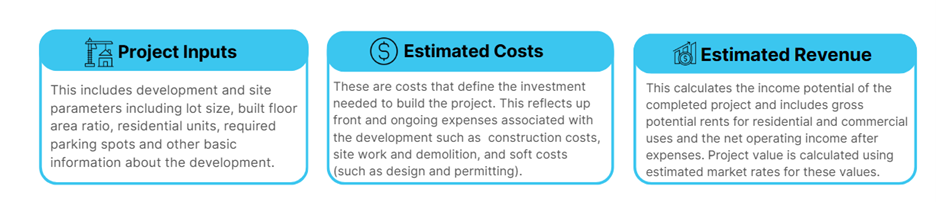
Analysis inputs include:
- Project Inputs – the development and site parameters including lot size, built floor area ratio, residential units, parking spots, etc.
- Estimated Costs – includes up front and ongoing expenses associated with development, such as construction costs, site work, demolition, etc.
- Estimated Revenue – this calculates the income potential of the complete project and includes gross potential rents for residential and commercial uses and the net operating income after expenses.
Financial Feasibility Analysis Outputs
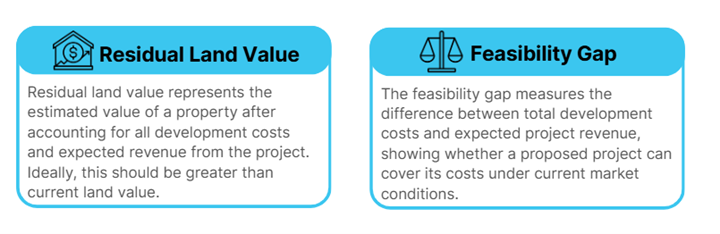
Analysis outputs include:
- Residual Land Value – represents the estimated value of a property after accounting for all development costs and expected revenue form the project.
- Feasibility Gap – measures the difference between total development costs and expected project revenue.
Land Value Quotient Analysis
As part of the financial feasibility toolkit, Forward Pinellas uses a Land Value Quotient (LVQ) analysis to understand how a potential development impacts land value in a specified geographic area, such as a zoning district. The LVQ analysis is integrated into the financial feasibility analysis toolkit and compares the projected land value from potential redevelopment of a property to the current land value of the surrounding area, providing insight into whether proposed development regulations are likely to increase the value of land relative to surrounding properties. This analysis allows us to:
- Assess whether proposed regulations are likely to increase land value and support economic growth
- Estimate the potential impact on local tax base from redevelopment under different scenarios
- Support parcel-level financial feasibility analysis with an understanding of impacts relative to comparative properties in a community
By incorporating the LVQ into the financial feasibility analysis toolkit, Forward Pinellas provides local governments with a quantitative, outcome-focused perspective of how land use policies can influence long-term community value and economic development.

Transportation & Benefit-Cost Analysis (BCA)
Forward Pinellas applies quantitative and economic analysis to prioritize transportation projects for funding through a Benefit-Cost Analysis (BCA) Tool. By using structured frameworks such as BCA, we evaluate how proposed transportation improvements affect safety (e.g. crash reduction) and mobility (e.g. travel time savings and reduced vehicle miles traveled) and express these improvements as quantified benefits relative to project costs.
BCA compares the estimated benefits of a transportation project to the total cost required to construct and maintain it. This data-driven approach provides a way to assess whether a project is likely to deliver long-term value to a community. BCA frameworks and methodology are well-established and required by the federal government for grant applications. By scaling this structure to our project prioritization process, Forward Pinellas can quantify local costs, benefits, and impacts from transportation improvements.
Forward Pinellas has an established prioritization process for funding transportation projects, which scores projects based on factors vital to our goal of connecting communities in Pinellas County. The BCA will be incorporated into this prioritization process to strengthen our ability to compare projects objectively and support strategic allocation of limited transportation funding, ensuring that investments are transparent, defensible, and aligned with long-term transportation goals.

These tools require periodic updating to reflect accurate market conditions, and Forward Pinellas will continue to evolve these tools to support our decision-making needs. Economic analysis tools help us approach our work with a data-driven perspective, ensuring more confidence and transparency in our recommended policies and projects.