In an effort to better serve the local communities in Pinellas County, Forward Pinellas is pleased to provide the Knowledge Exchange Series. We are conducting research and providing technical assistance on topics that shape the way Pinellas County redevelops. Please visit forwardpinellas.org for future projects in the Knowledge Exchange Series.
Research on bicycle parking is essential for promoting sustainable transportation, informing urban planning and design, addressing issues of transportation, and promoting health and well-being. Providing people who ride bicycles a designated parking area ensures that bicycles are parked in an orderly and unobtrusive manner, playing a key role in improving cycling infrastructure as a whole, whether in public, commercial or residential settings.
Bicycle friendly infrastructure, parking, programs, and policies that support bicycling significantly increase levels of bicycling. According to a New York City Bicycle Survey, the top reason respondents do not commute to work by bicycle is due to lack of safe bicycle storage; affecting 50% of respondents.
So, how can we adapt our codes to support bicycle parking?
Project Contact: Kyle Simpson
Email: ksimpson@forwardpinellas.com
Phone: 727.464.5580

Types of Bicycle Parking
Short-Term Parking
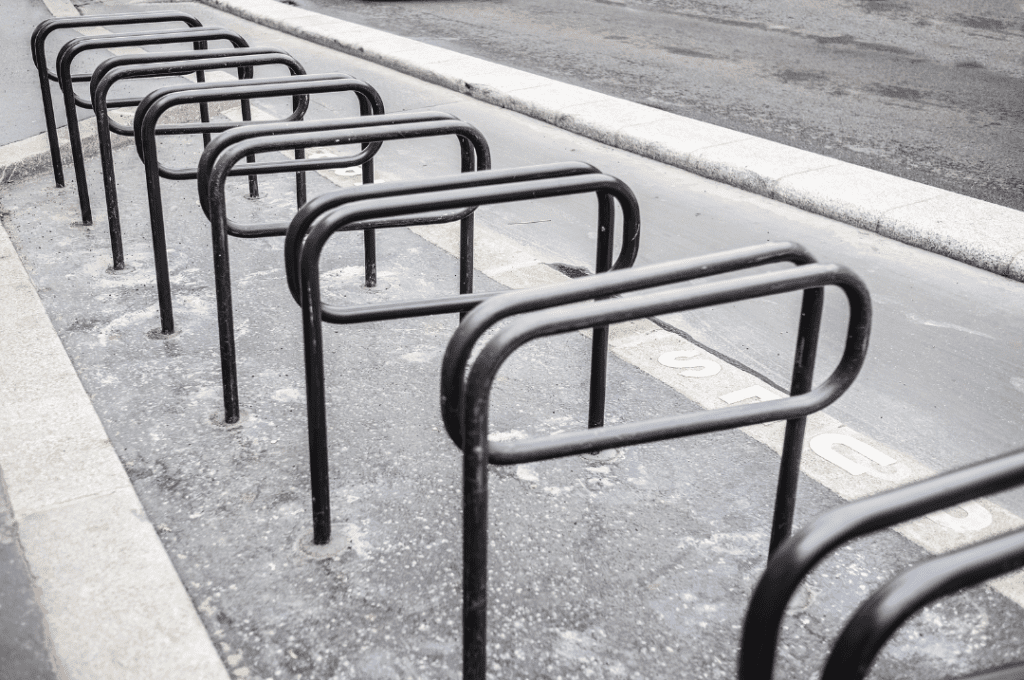
Short-term bicycle parking is outside and typically unsheltered/unenclosed. The goal of short-term bicycle parking is to provide parking for less than two hours and is typically in the form of a bicycle rack. The primary advantage of short-term bicycle parking is high convenience as it is often located in the most central, high-traffic areas. Bicycle racks also provide a more secure option than sign poles or other street furniture to lock bicycles to, helping to reduce the chance of theft.


Long-Term Parking
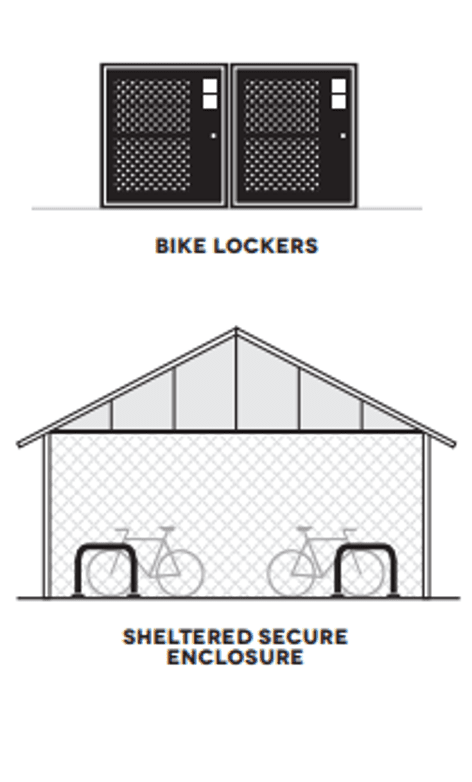
Long-term bicycle parking on the other hand is far more sheltered with added protection and enclosure. Bicycles parked in long-term bicycles parking areas can be stored for extended periods of time. Long-term bicycle parking comes in the form of bicycle lockers and enclosures, which include bicycle shelters, bicycle rooms, and bicycle parking stations. The advantage of long-term bicycle parking is that it has a high level of protection against bicycle theft as it offers an enclosed space.
Bicycle Types
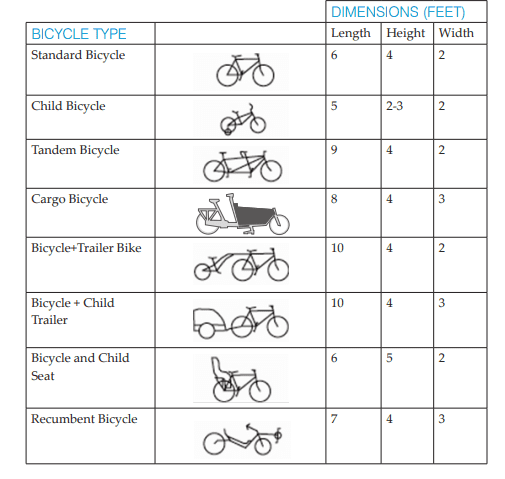
When designing a bicycle parking space, the wide variety of bicycle types and sizes need to be considered. Larger clearances are recommended to accommodate parking of bicycles that are longer and/or wider than a typical bicycle. Below is a visual guide to identifying different bicycles and their spacing requirements.
Bicycle Parking Spacing Guidelines
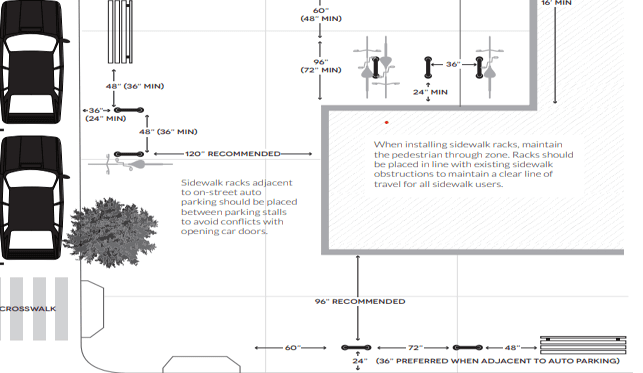
For common inverted-U and post-and-ring racks, clearances of six feet (length) x two feet (width) per bicycle are recommended, with five feet by 18-inches being the minimum standard for any vertical obstruction like walls or street trees. Since cargo bicycles and trailers extend beyond standard dimensions, requiring dedicated zones or wider individual spaces can be helpful when including them. Some cities infuse the space with color, signage, or even art to create a welcoming atmosphere that fosters community among bicyclists.
Best Practice Examples
U.S. Cities such as St. Petersburg, Kansas City, Boston, Seattle, and Charlotte have strong provisions in their development codes for bicycle parking, some of which are highlighted below. For instance, in developed areas like Pinellas County, minimum vehicular parking requirements can limit the redevelopment potential of existing developments, especially on small parcels. Allowing administrative reductions in the minimum amount of vehicular parking required by providing additional bicycle parking can facilitate economic development and reduce the barrier of variances to vehicular parking codes. The following communities provide for administrative reductions in the required minimum amount of vehicular parking.
St. Petersburg, Florida
Portland, Oregon
Seattle, Washington
Charlotte, North Carolina
Minneapolis, Minnesota
Kansas City, Missouri
Click to view Bicycle Parking Comparison Spreadsheet.
Other Emerging Trends
- Micro-mobility integration is on the rise.
- Many cities are incorporating Electric Bicycle Charging Stations in public parks. By combining the convenience of public parks with the growing popularity of e-bicycles, smart electric bike charging stations offer an ideal solution to enhance sustainability.
- The City of Portland adopted a code requirement that 5% of bicycle parking must be near an outlet in a 2019 bike parking code update project.

Sources:
Association of Pedestrian and Bicycle Professionals (APBP) (2015). Essentials of Bike Parking. Retrieved from https://www.apbp.org/assets/docs/EssentialsofBikeParking_FINA.pdf.
Charlotte, NC. (2016). Code of Ordinances. Retrieved from https://library.municode.com/nc/charlotte/codes/code_of_ordinances/264937?nodeId=PTIICOOR_APXAZO_CH12DESTGEAP_PT2OREPALO_S12.202ABIPAST.
Kansas City, MO. (2023). Zoning and Development Code. Retrieved from https://library.municode.com/mo/kansas_city/codes/zoning_and_development_code?nodeId=ZODECOKAMI_400_SERIESDEST_88-420PALO_88-420-09BIPA.
Minneapolis, MN. (2024). Code of Ordinances. Retrieved from https://library.municode.com/mn/minneapolis/codes/code_of_ordinances?nodeId=MICOOR_TIT20ZOCO_CH541OREPALOMO_ARTIIISPOREPARE_541.320BIPARE.
MuniCode (2019). Seattle, WA Parking Requirements. Retrieved from https://www.munistandards.com/wa/seattle/parking-requirements/.
NYC Department of City Planning (2007). NYC Bike Survey [PDF]. Retrieved from https://www.nyc.gov/assets/planning/download/pdf/plans/transportation/bike_survey.pdf.
Portland Bureau of Transportation (PBOT) (2020). Bicycle Parking Code Update. Retrieved from chrome-extension://efaidnbmnnnibpcajpcglclefindmkaj/https://www.portland.gov/sites/default/files/2021/bike-parking.adopted.final-final-final.pdf.
Reliance Foundry (n.d). Why Bike Theft Matters. Retrieved from https://www.reliance-foundry.com/blog/secure-bike-parking-customers.
St. Petersburg, FL. (2024). Code of Ordinances. Retrieved from https://library.municode.com/fl/st._petersburg/codes/code_of_ordinances?nodeId=PTIISTPECO_CH26TRVE_ARTVBI.
Visit St. Pete/Clearwater (2024). St. Petersburg Black History Bike Tour. Retrieved from https://www.visitstpeteclearwater.com/event/st-petersburg-black-history-bike-tour/47426.